The failure mode that keeps refractory engineers awake is not catastrophic spalling. It's the slow, ambiguous kind: green strength that looks acceptable at room temperature, then loses 15–25% of its modulus of rupture somewhere between 400°C and 700°C before the ceramic bond fully develops. The binder was blamed. Nine times out of ten, the binder wasn't the problem. The ratio was.
Aluminum Dihydrogen Phosphate—ADP, , CAS13530-50-2, HS Code 2835299000—is not a forgiving material. It rewards precise formulation and punishes approximation. What follows is a technical breakdown of why that is, and what to do about it.
ADP is a coordination compound in which aluminum is bound to three dihydrogen phosphate ligands. In solution or in its powder form, it behaves as a polyfunctional acid. On heating, it undergoes a staged dehydration and polycondensation sequence that is directly responsible for both its bonding utility and its failure modes.
The reaction cascade, simplified:
The intermediate at 400–600°C is where most field failures originate. The amorphous AlPO₄ phase is mechanically weak, and if the heating rate through this window is too fast—or if the molar ratio is poorly controlled—you accumulate an under-condensed phosphate glass that softens rather than stiffens.
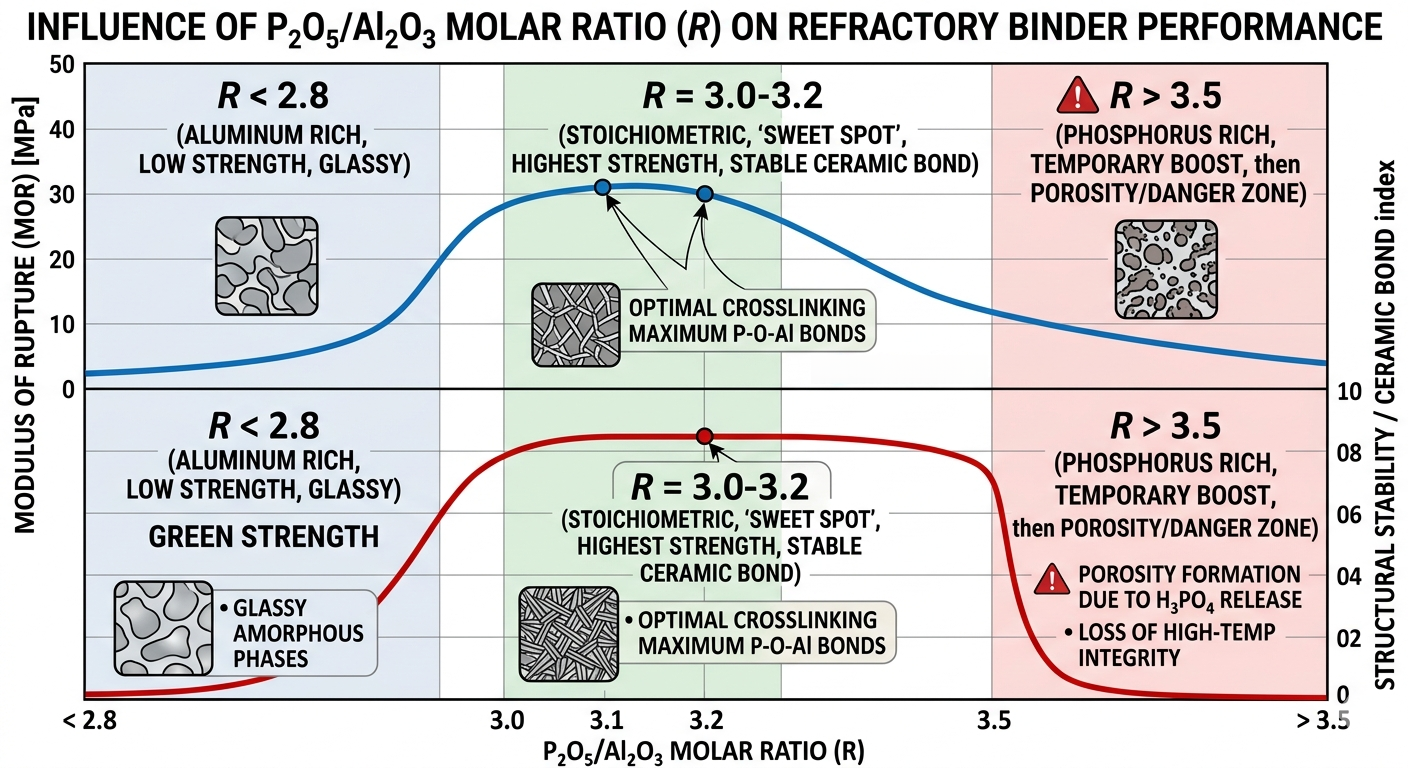
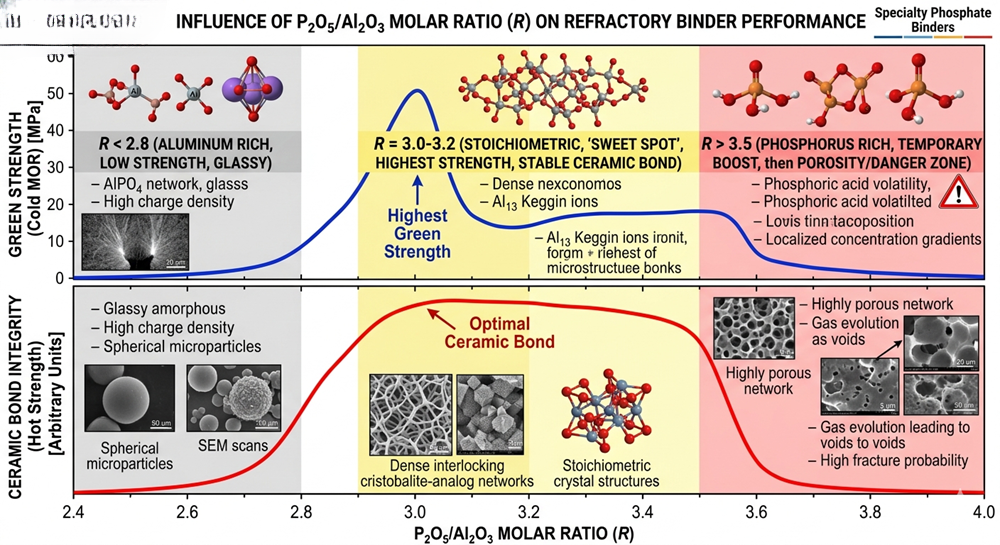
This ratio is the single most important specification variable in ADP binder chemistry. It is rarely listed on commodity datasheets. It should be.
At R < 2.8, the system is aluminum-rich. Excess Al³⁺ acts as a network modifier in the phosphate glass, suppressing viscous flow at intermediate temperatures and improving green strength development. The downside: slower dissolution rate in liquid formulations, and risk of aluminum orthophosphate precipitation in storage.
At R = 3.0–3.2, you are in the stoichiometric ADP window. This is the formulation sweet spot for most gunning mix applications—fast set, predictable strength development, clean ceramic bond formation above 900°C.
At R > 3.5, the system becomes phosphorus-rich. Residual free phosphoric acid accelerates room-temperature set (useful in rapid-repair scenarios) but introduces volatility in the 500–700°C range as excess releases, generating a temporary porosity spike that degrades thermal shock resistance.
The practical takeaway: specifying ADP by content alone—as most procurement documents do—is insufficient. Demand the molar ratio from your supplier. If they cannot provide it with batch-level traceability, that tells you something important about their quality system.
The industry treats this as a convenience choice. It is an engineering choice with measurable consequences for application performance, logistics cost, and total cost of ownership.
Liquid ADP (typically supplied at 40–50% concentration, specific gravity 1.35–1.55 g/cm³) is a Newtonian fluid at low shear rates. It disperses homogeneously through refractory castable or gunning mix matrices within 60–120 seconds of paddle mixer contact. There is no hydration induction period. The phosphate anion reaches the aggregate surface immediately, initiating the acid-base reaction with aluminum-bearing phases (corundum, calcined alumina, reactive alumina micro-fines) on contact.
Powder ADP (typically ≥ 95% purity, bulk density 800–950 kg/m³) behaves differently. On contact with water in the mix, it first requires dissolution—an endothermic step that competes with the exothermic bonding reaction. The effective mixing window is 3–5 minutes longer than liquid equivalent formulations. In precast shapes with tight dimensional tolerances, this extended working time can be an advantage. In gunning operations with fast rebound and short set requirements, it is a liability.
The rheological gap widens further at low water-to-binder ratios. Powder ADP at w/b < 0.25 generates localized concentration gradients around partially dissolved granules—"hot spots" of high phosphate activity surrounded by unreacted binder. The result is non-uniform green strength distribution across the cross-section of a precast block, detectable only by destructive core sampling.
Liquid ADP ships at 40–50% active content, meaning you are paying to transport 50–60% water across an ocean freight route. For a 20-foot container load at 20 MT net weight, you are moving approximately 10–12 MT of water at full freight cost. CFR Mumbai or CFR Ho Chi Minh City, that difference in effective active-ingredient cost is USD 40–80/MT of dry equivalent, depending on route.
Powder ADP eliminates this. It ships at ≥ 95% active content, at roughly half the volumetric freight cost per unit of phosphate delivered. For plants with dry mixing capability—standard in any modern refractory production facility—powder ADP is the economically rational choice at scale.
The exception is on-site gunning operations in steelworks, where liquid ADP eliminates a dissolution step that cannot be reliably controlled under field conditions (variable water quality, ambient temperature swings, operator-dependent mixing time). In that specific context, the freight premium for liquid is justifiable on quality-control grounds alone.
In pneumatic gunning, binder behavior is governed by two competing requirements: the material must remain workable through the hose and nozzle (typically 6–15 meters of transport distance), then set rapidly on the hot surface to minimize rebound loss.
ADP binder concentration in gunning mixes is typically 2.5–4.5% by dry weight, with liquid ADP preferred at the nozzle-injection point for the reasons discussed above. The critical variable is the hot-face temperature at time of application: below 150°C, ADP sets primarily through water evaporation and physical film formation—adequate for temporary sealing but structurally weak. Above 200°C, the dehydration condensation reaction proceeds rapidly, and green strength development is accelerated.
Iron contamination in the binder becomes disproportionately damaging in gunning applications. ions catalyze premature phosphate polymerization, causingnozzle blockage and variable rebound rates across a single gunning session. A specification of in the ADP binder is not conservative—it is the minimum threshold for consistent gunning performance.
In precast refractory manufacture—ladle linings, tundish furniture, burner blocks, tap-hole surrounds—ADP functions within a more controlled environment. Mixing, casting, and cure are sequential operations with defined process windows.
Here the ratio precision matters most. Precast shapes for applications above1400°C (continuous casting tundishes, electric arc furnace roofs) require a binder that transitions cleanly from the amorphous AlPO₄ intermediate to the high-cristobalite ceramic bond without generating excessive porosity in the 500–800°C window. This demands R = 3.0–3.2, tightly held.
impurity is the hidden enemy in precast applications. Sodium lowers the viscosity of the phosphate glass phase at intermediate temperatures, promoting flow and dimensional instability during initial firing. In precision precast components—nozzle sleeves, stopper rods, porous plugs—a content above0.08% in the binder has been correlated with dimensional deviation exceeding 0.3% of nominal in linear shrinkage measurements. That sounds small until you are fitting a nozzle sleeve into a continuous caster plate frame with a ±0.2 mm tolerance.
Our specification at Tairan holds for all ADP grades supplied to precast manufacturers. This is not a marketing specification. It is derived from 20 years of failure analysis data and customer process audits.
| Parameter | Liquid ADP (Standard) | Liquid ADP (High-Purity) | Powder ADP (Standard) | Powder ADP (Refractory Grade) |
|---|---|---|---|---|
| Concentration / Purity | 40–42% | 48–50% | ≥ 93% | ≥ 96% |
| P₂O₅/Al₂O₃ Molar Ratio | 3.0–3.5 | 3.0–3.2 | 3.0–3.5 | 3.0–3.2 (controlled) |
| Fe₂O₃ | ≤ 0.08% | ≤ 0.05% | ≤ 0.08% | ≤ 0.05% |
| Na₂O | ≤ 0.10% | ≤ 0.05% | ≤ 0.10% | ≤ 0.05% |
| Free Acid (as H₃PO₄) | ≤ 3.0% | ≤ 2.0% | ≤ 2.5% | ≤ 1.5% |
| Density / Bulk Density | 1.35–1.47 g/cm³ | 1.47–1.55 g/cm³ | 850–950 kg/m³ | 800–880 kg/m³ |
| Mixing Behavior | Immediate dispersion | Immediate dispersion | 3–5 min dissolution | 3–5 min dissolution |
| Primary Application | Gunning mixes, site mixing | Precision precast, porous plugs | Industrial castables, dry mixes | High-precision precast, stopper rods |
| Recommended Use Temp. | Up to 1400°C | Up to 1700°C | Up to 1400°C | Up to 1700°C |
| Freight Efficiency (TCO) | Baseline | Baseline +12% | +35–45% vs. liquid | +35–45% vs. liquid |
| Anti-Caking / Stability | N/A — monitor settling | N/A — monitor settling | Requires silica coating | Coated + N₂ flush packaging |
Selection rule of thumb: if your application involves temperatures above 1450°C, a dimensional tolerance tighter than ±0.5%, or continuous casting contact, specify Refractory Grade Powder ADP with a confirmed ratio. Everything else can be evaluated against freight economics.
We produce ADP at our Zhengzhou facility using food-grade orthophosphoric acid (, Fe ≤ 10 ppm at input) and high-purity aluminum hydroxide with a controlled particle size D90 < 40 μm. The synthesis is a continuous reactor process, not batch kettle—which matters because it eliminates the concentration gradients at the beginning and end of batch cycles that are responsible for the ratio drift seen in kettle-produced material.
On impurity control: our production target for in Refractory Grade ADP is≤ 0.03%, which is 40% tighter than our published specification. The headroom exists because raw material quality varies, and we hold the product specification at a level we can consistently meet—not a level we hit on good days.
On physical stability: powder ADP is hygroscopic. At relative humidity above 65%, uncoated product begins surface hydration within 48 hours, forming a sticky crust that clumps particles and raises the effective free acid content through localized concentration. Over 24 container-loads of export experience, we have standardized on surface-treated powder with microcrystalline silica coating (0.3–0.5% w/w) combined with nitrogen-flushed, moisture-barrier PE liner bags within steel drums. Measured moisture uptake over a 90-day simulated sea transit in our accelerated aging protocol: < 0.2% weight gain.
Liquid ADP carries a different stability risk: supersaturation at concentrations above 48% can nucleate and precipitate in cold-chain disruptions below8°C. Every liquid ADP shipment from our facility includes a re-dissolution protocol in the technical data sheet, with verified recovery data showing that properly re-dissolved settled product retains ≥ 98% of the original bonding performance. We test this. The certificate accompanies the shipment.
Batch traceability: every production lot carries an ICP-OES report (Al, P, Fe, Na, Ca, Si), a molar ratio calculation from certified analysis, and a shelf-life projection based on packaging conditions and destination climate zone. For customers supplying continuous casting operations—where a binder failure is a casting stoppage worth tens of thousands of dollars per hour—this documentation is not optional.
ADP binder chemistry is well-understood in the literature. The failures that occur in industrial practice are almost never chemical in origin. They are specification failures: the wrong ratio, the wrong purity grade, the wrong physical form for the mixing process, or the right product that arrived in the wrong condition after a poorly managed supply chain.
Specify ratio. Specify and limits. Ask for the accelerated aging data on powder anti-caking performance. Ask whether the liquid product has been tested for low-temperature stability.
If a supplier cannot answer those questions with data, you are buying commodity phosphate. The price will look attractive until the first failed casting run.
Technical inquiries, batch-level certificates, and application engineering consultations: contact the Specialty Phosphate Division at Henan Tairan Chemical Co., Ltd.
All process data and case performance figures referenced in this document are derived from Tairan Chemical's internal R&D records and customer application audit reports accumulated over a 20-year production history.