Ask any production manager who has stood next to a ball mill at 2 AM troubleshooting a batch of sluggish slurry, and they'll tell you the same thing: slurry rheology is where ceramic production is won or lost. Get the fluidity wrong, and every downstream process — mold filling, spray drying, pressing, firing — inherits the problem.
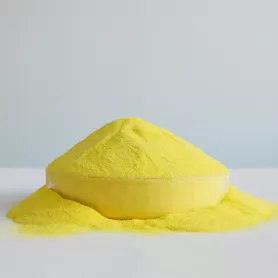
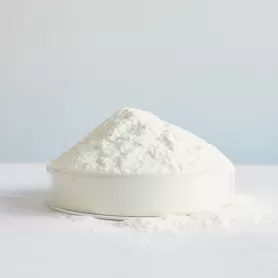
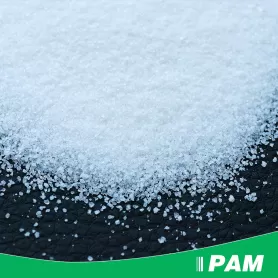
Sodium Hexametaphosphate, (NaPO3)6, has earned its place as the industry's preferred deflocculant not through marketing, but through decades of consistent performance on production floors from Morbi to Foshan to Kerama.
The mechanism is straightforward, and the effect is immediate:
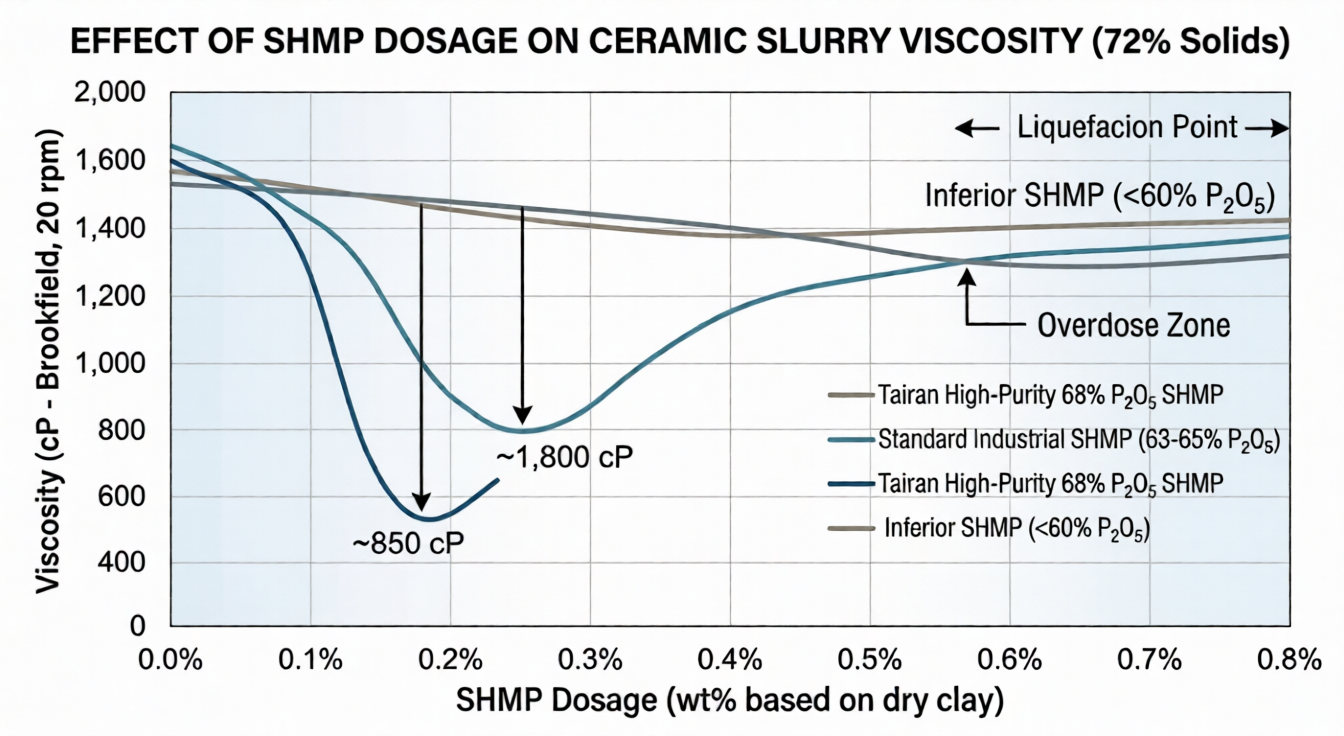
SHMP works by chelating the calcium and magnesium ions naturally present in clay-water systems — the very ions responsible for flocculating clay particles and driving up viscosity. Once those ions are sequestered, SHMP molecules adsorb onto clay particle surfaces, increasing the negative surface charge and generating electrostatic repulsion between particles. The Zeta potential shifts decisively into stable dispersion territory. The result: a dense, high-solid slurry that flows like water.
At an addition rate of just 0.1%–0.5% by dry weight, a slurry that would otherwise require excessive water to become workable becomes fluid enough to spray, pump, and fill with precision.
This is where I need to be direct with you, because this is where purchasing decisions made purely on price create problems that are far more expensive than the savings.
Not all SHMP is the same product. A bag labeled ’SHMP’ with 60% P2O5P_2O_5 P2O5 and a bag with 68% P2O5P_2O_5 P2O5 are chemically distinct in ways that show up visibly on your finished tile — and by then, the damage is already done.
① P2O5 Content ≥ 68% — Chelation Capacity Directly Determines Efficiency
P2O5 content is not an abstract purity number. It is a direct measurement of the active chelating capacity of the product. Higher P2O5 means more phosphate chains available to sequester calcium and magnesium ions per kilogram of product used.
In practical terms: a plant running 68% SHMP can achieve the same deflocculation effect with measurably less product than one running 60–63% material. Over a month of continuous production, that difference in consumption rate compounds into a significant cost gap — one that the lower unit price of inferior-grade SHMP rarely compensates for.
② Fe Content < 0.02% — The White Tile Problem No One Wants to Explain to a Customer
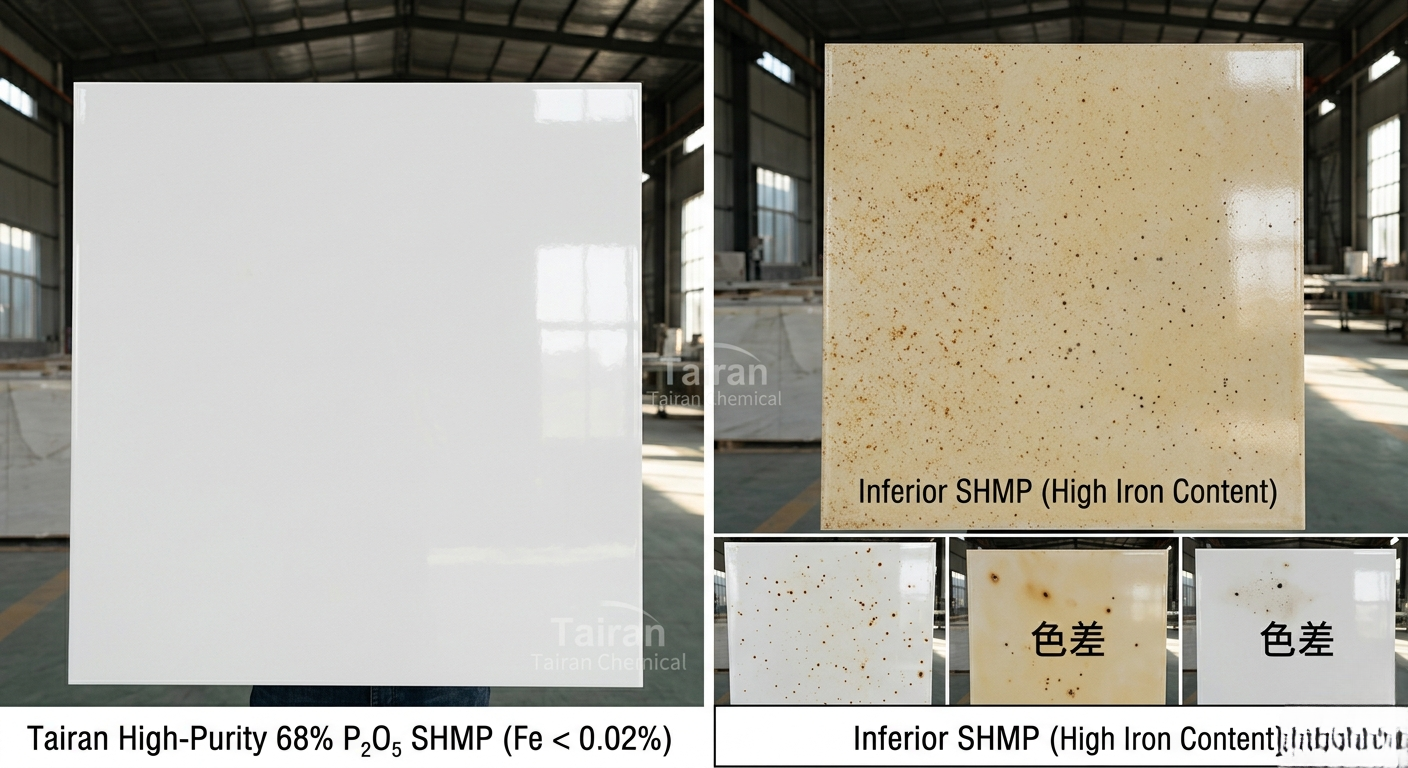
Iron contamination is the silent killer of high-end ceramic production. At iron levels above 0.02%, you are introducing a colorant into your body and glaze system — one that you did not formulate and cannot easily control.
The consequences are well-documented by anyone who has processed a reject batch:
● Red or rust-colored speckling on white-body wall tiles
● Yellowish glaze tone on polished porcelain, particularly visible in controlled lighting
● Dark spots on matte surfaces caused by iron oxide concentration at grain boundaries during firing
For commodity floor tile, some producers tolerate this. For any product competing on surface quality — polished porcelain, large-format slabs, sanitary ware — iron above this threshold is simply not acceptable. The specification Fe < 0.02% exists because production experience demands it.
③ Insoluble Matter ≤ 0.05% — Protecting Your Spray Dryer
Spray dryer nozzles operate under high pressure with tight tolerances. Undissolved solids in the slurry feed — even in small quantities — accumulate at nozzle orifices, disrupting droplet formation and ultimately causing uneven granule size distribution. The downstream effect is inconsistent pressing density, which translates to differential shrinkage during firing and increased warpage rejection rates.
This is not a theoretical risk. It is a maintenance and quality issue that production teams in high-output plants encounter regularly when sourcing switches to lower-specification material.
Technical specifications only matter if they translate into numbers that appear on a production cost report. Here is where the 68% SHMP standard makes its strongest argument.
Reduced Water Demand = Direct Fuel Savings in Spray Drying
Effective deflocculation allows formulators to reduce the water content of slurry by 3–5 percentage points while maintaining equivalent flow properties. In a spray drying operation, water is the enemy of energy efficiency — every kilogram of water that enters the tower must be evaporated, and that evaporation is paid for in fuel.
A 3–5% reduction in slurry moisture content at constant throughput translates directly to measurable reductions in natural gas or coal consumption per tonne of powder produced. For a mid-scale plant running multiple spray dryers continuously, this is not a marginal gain.
Higher Green Body Density = Fewer Fired Cracks
When deflocculation is effective and uniform, clay particles pack more densely and homogeneously during pressing. A more uniform green body density means more predictable and consistent firing shrinkage across the tile surface — which means fewer warped tiles, fewer cracked tiles, and a lower overall rejection rate coming off the kiln.
Smoother Glaze Suspension = Cleaner Fired Surface
Glaze slurries benefit from the same deflocculation principles as body slurries. Properly dispersed glaze maintains particle suspension uniformly, preventing settling gradients that cause uneven application thickness. The result after firing is the flat, defect-free glaze surface that premium products require.
Twenty years of watching plants use this product incorrectly has produced two pieces of advice worth emphasizing:
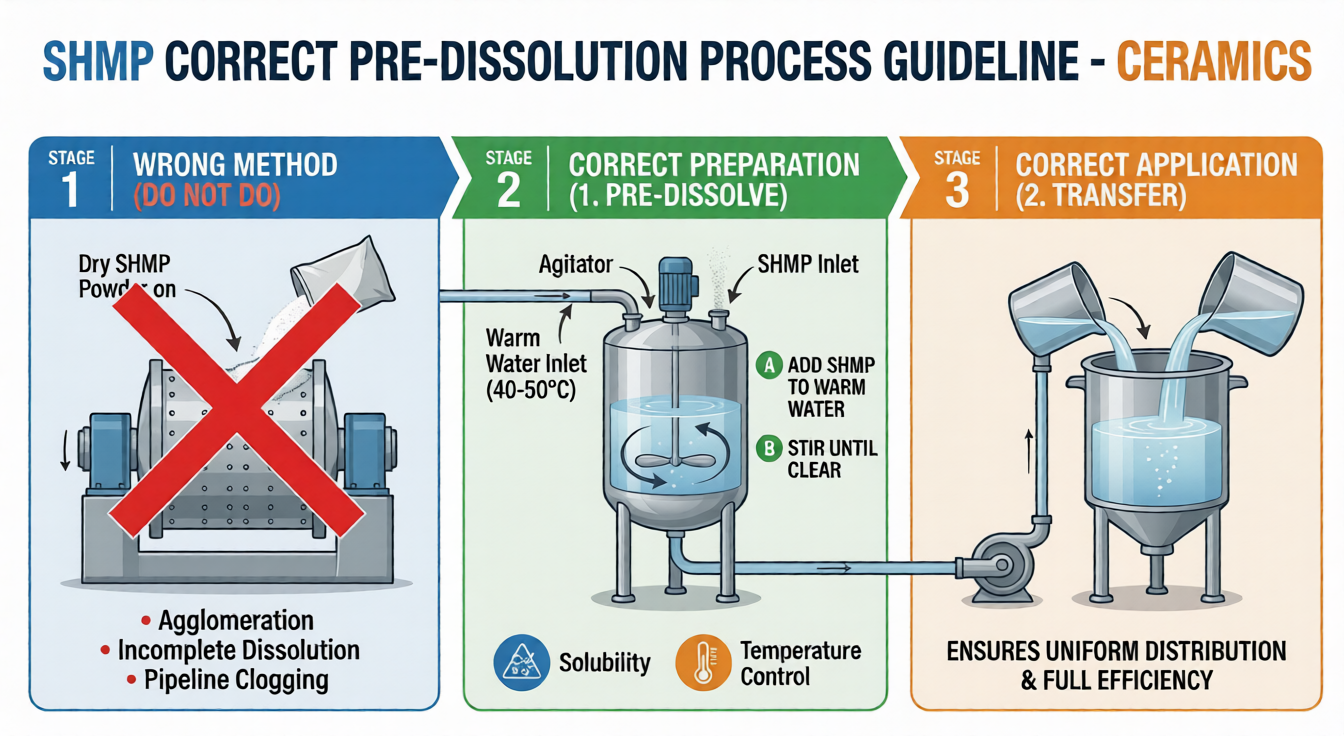
Dissolve before you add, not inside the mill.
SHMP should be pre-dissolved in warm water (40–50°C) to form a clear solution before introduction into the ball mill or blunger. Adding dry powder directly risks incomplete dissolution, localized overdose, and uneven distribution through the slurry batch. The extra five minutes of preparation time pays for itself in consistency.
Moisture is the enemy of stored SHMP.
(NaPO3)6 is hygroscopic. Bags that have been improperly stored in humid conditions will exhibit partial hydrolysis and caking. Caked SHMP dissolves slowly and unevenly, and its effective chelation capacity is reduced. If product arrives with visible agglomeration beyond normal handling consolidation, treat it as a quality flag — test the P2O5 content before committing it to production batches.
Understanding a product's chemistry is one part of the equation. Understanding the logistical realities of getting that product to a production facility in workable condition is the other.
South Asia — Morbi and Vietnam
The ceramic cluster in Morbi, Gujarat, operates through one of the world's most demanding monsoon seasons. Standard packaging fails in high-humidity conditions through moisture ingress that begins degrading product quality before it reaches the plant floor.
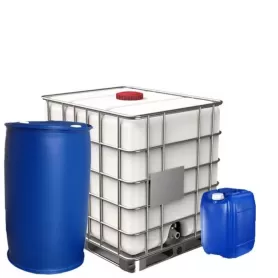
Our South Asia shipments use a dual-layer moisture-barrier packaging system specifically designed for the humidity profiles of Gujarat and the Mekong Delta. Product reaching Morbi or Ho Chi Minh City in August should perform identically to product shipped in January. We have engineered our packaging to ensure it does.
Russia — Western and Siberian Markets
For clients receiving product via China-Europe rail or through Novorossiysk, we maintain a confirmed P2O5 specification of ≥ 68.2% — not the minimum, but consistently above it — to provide a quality buffer that accounts for extended transit times and temperature variation across the Eurasian landmass. Our certificates of analysis travel with every shipment and reflect actual batch testing, not specification limits.
The choice of SHMP grade is not a procurement detail. It is a production quality decision that affects slurry behavior, spray dryer efficiency, green body consistency, fired tile surface quality, and ultimately, the rejection rate and fuel cost that appear on your monthly P&L.
The 68% P2O5, Fe < 0.02% standard exists because production experience across the global ceramics industry has validated it repeatedly. It is the specification that eliminates the variables you cannot afford to manage in a high-volume continuous operation.
Tairan Chemical supplies this standard consistently, packaged for the markets we serve, backed by technical support that starts before the first order is placed.
Contact our technical team to request a product data sheet, a certificate of analysis from current production stock, or a sample for in-plant evaluation.
Tairan Chemical — Precision Chemistry for Industrial Production, Delivered Globally.