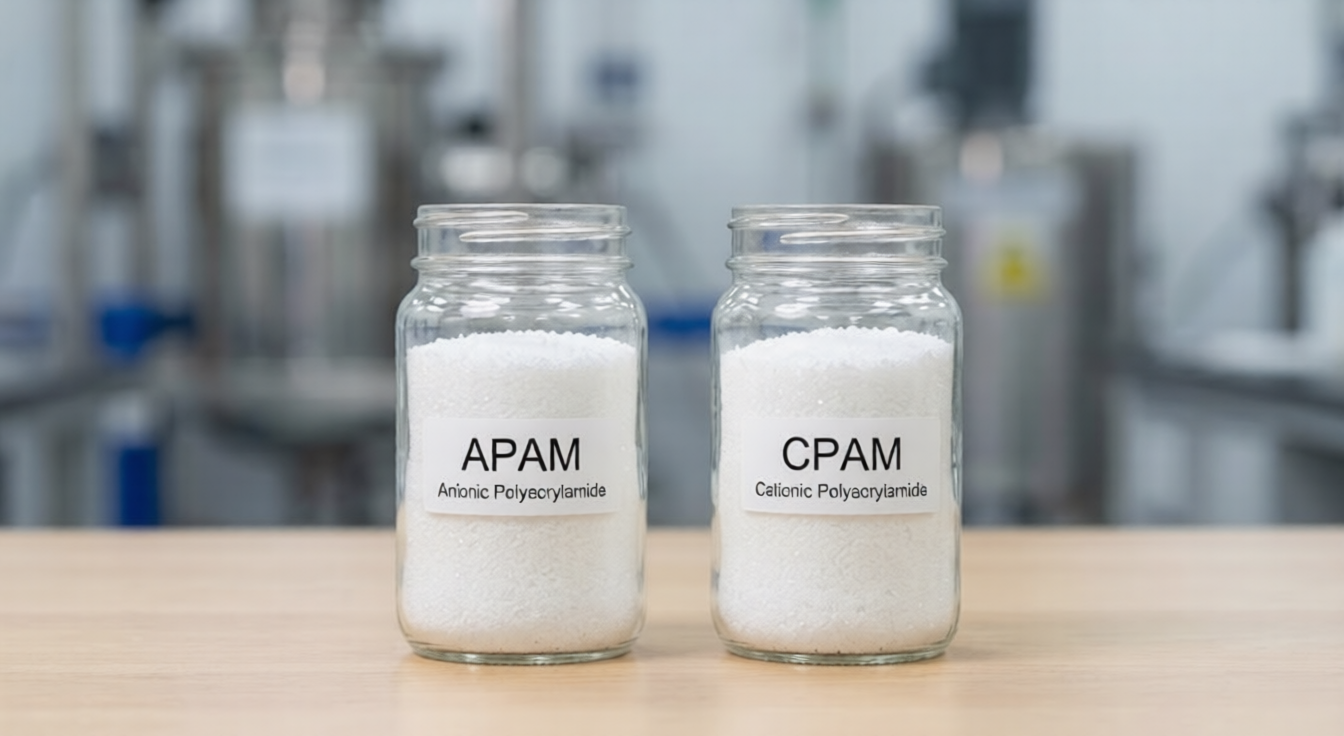
Choosing the wrong type of polyacrylamide (PAM) can reduce treatment efficiency by 40–60% and increase chemical costs unnecessarily. Yet many operators still select PAM based on price alone—or use whatever was ordered last time.
This guide explains the core differences between anionic and cationic PAM, their best-fit applications, and a practical framework to help you choose correctly the first time.
Polyacrylamide is a water-soluble polymer widely used in wastewater treatment as a flocculant or coagulant aid. It works by bridging fine suspended particles together into larger flocs that can be easily settled or filtered.
PAM is available in three ionic forms:
● Anionic PAM (APAM) — carries a negative charge
● Cationic PAM (CPAM) — carries a positive charge
● Nonionic PAM — carries no charge (used in specific applications)
The ionic type determines which particles it attracts, how it interacts with water chemistry, and which treatment stage it performs best in.
| Property | Anionic PAM (APAM) | Cationic PAM (CPAM) |
|---|---|---|
| Charge | Negative (−) | Positive (+) |
| Typical molecular weight | 8–20 million Da | 4–12 million Da |
| Best for | Suspended solids, turbid water | Negatively charged particles, organic matter |
| Charge density | 10–30% | 20–80% |
| Sludge dewatering | Limited | Excellent |
| Cost | Lower | Higher |
| Dissolves in | Cold or warm water | Warm water preferred |
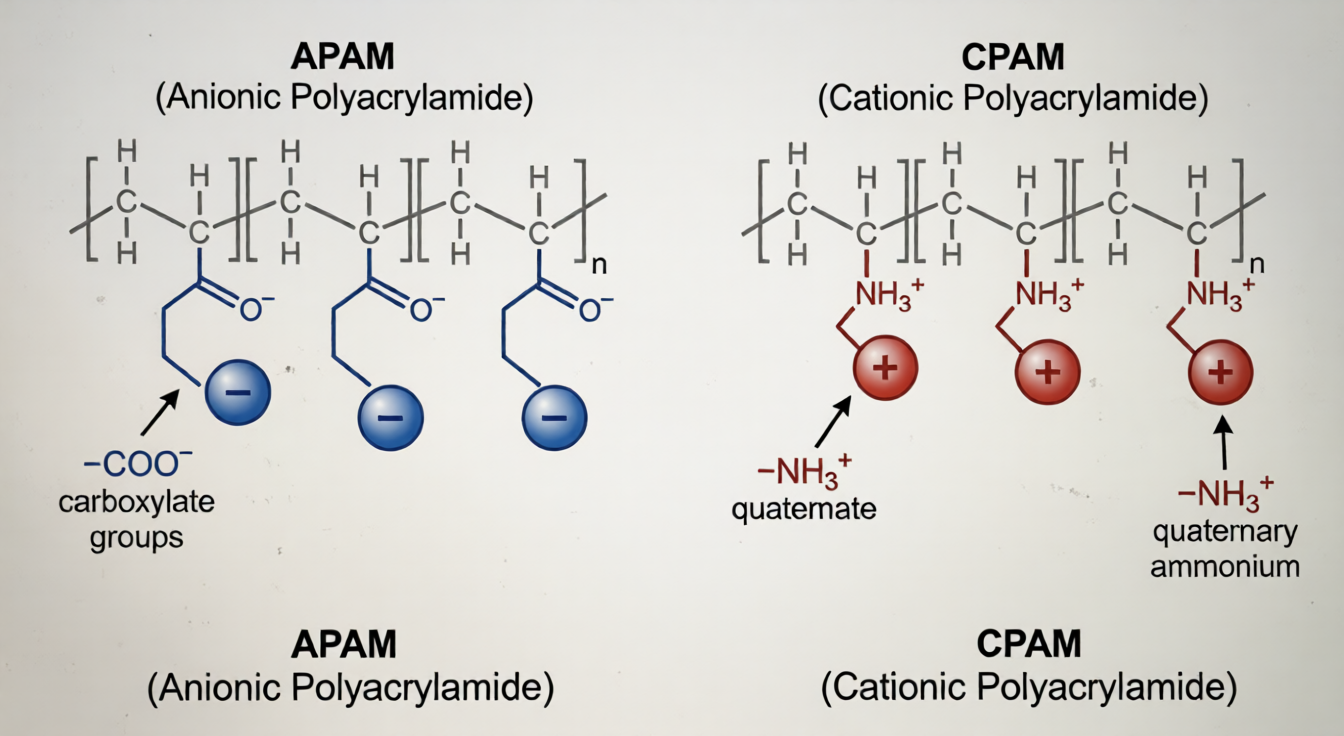
Anionic PAM is the most widely used type in industrial water treatment. It works best when:
1. Raw water has high suspended solidsAPAM is highly effective at capturing inorganic particles like silica, clay, and silt. These particles often carry a slight positive surface charge, which the negative APAM molecule can bridge effectively.
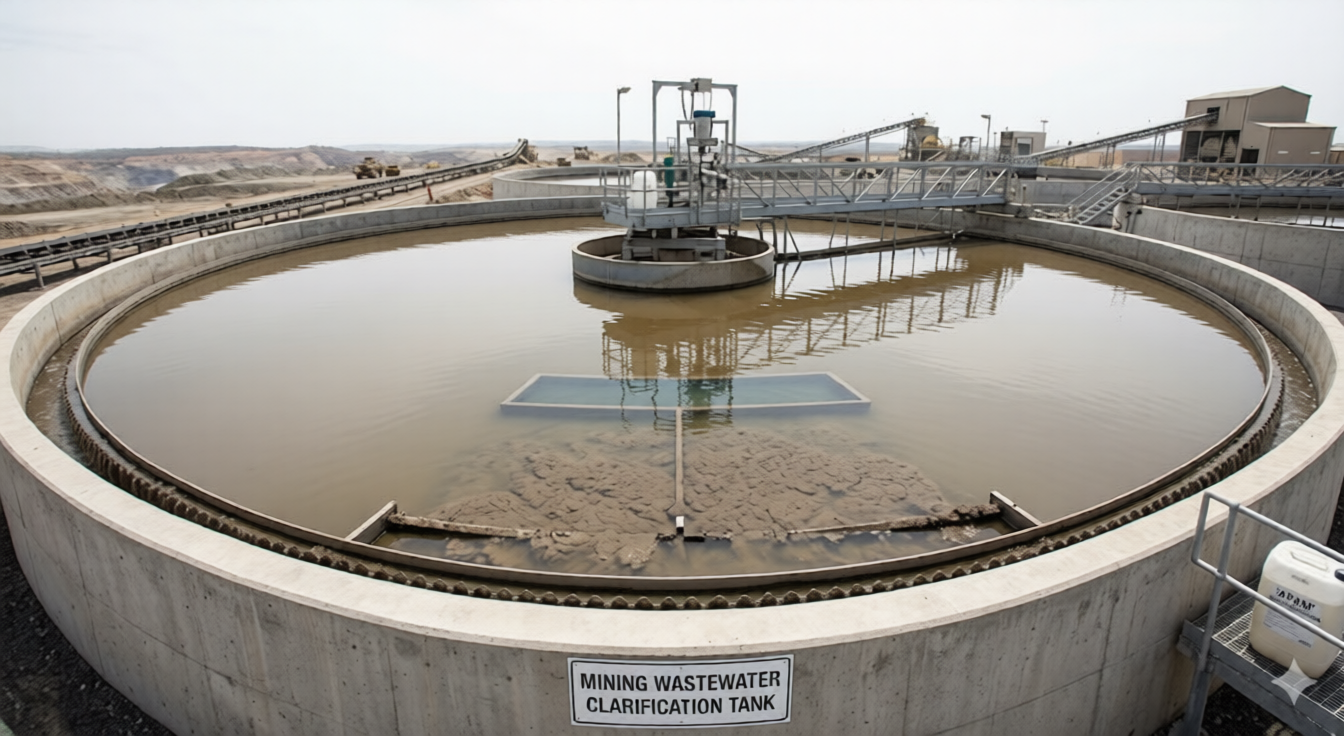
2. Treating mining, quarry, or construction runoffThese wastewaters contain large volumes of mineral solids. APAM with a molecular weight of 12–18 million Da and 20–30% anionicity typically delivers the best floc formation.
3. Working with an inorganic coagulantWhen used after PAC or alum, APAM acts as a flocculant aid to grow the flocs generated by the coagulant. This combination often reduces total chemical dosage by 20–40%.
4. Drinking water or food-grade applicationsFood-safe grades of APAM are approved for use in potable water treatment. Cationic PAM is generally not used in drinking water due to residual cationic monomer concerns.
Typical dosage for APAM: 0.1–2 mg/L in water treatment; 1–5 kg/ton dry solids in sludge handling
Cationic PAM is the preferred choice for organic-rich wastewaters and sludge. It works best when:
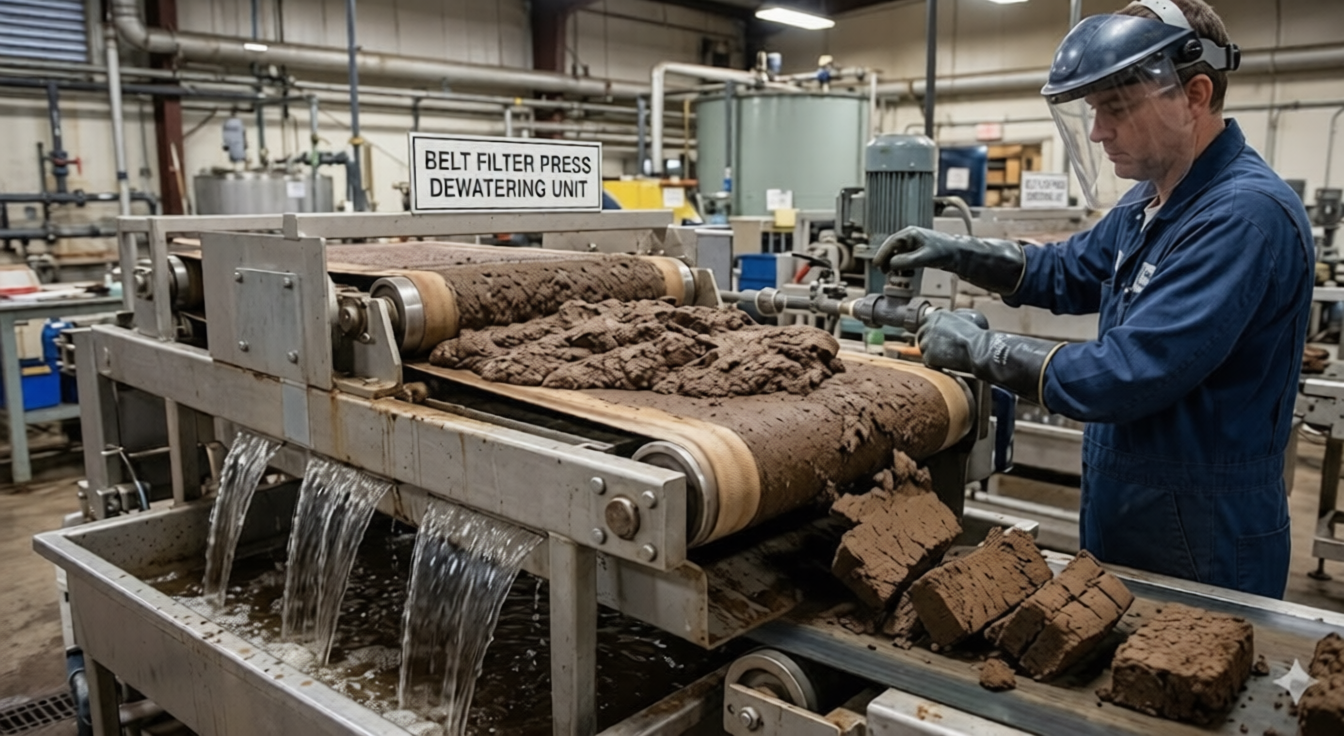
1. Sludge dewateringSludge particles (biological or industrial) carry strong negative charges. Cationic PAM neutralizes these charges and binds particles together, dramatically improving dewatering efficiency. A well-matched CPAM can reduce sludge moisture content from 98% to 75–80%.
2. Treating municipal or industrial wastewater with high organicsCPAM binds to negatively charged organic matter including proteins, fats, and biological solids. This makes it essential in food processing, paper mill, and municipal sewage treatment.
3. Paper and pulp industryCPAM is used both as a retention aid (keeping fine fibers on the wire) and a drainage aid (improving sheet formation). High charge density grades (60–80%) are common here.
4. Oil and gas produced waterProduced water contains emulsified oil and fine suspended solids with strongly negative charges. Cationic PAM with moderate-to-high charge density is effective for demulsification and solids separation.
Typical dosage for CPAM: 1–5 kg/ton dry solids in sludge; 0.5–3 mg/L in dissolved air flotation
| Water Type | Recommended PAM |
|---|---|
| River/lake water (turbid) | Anionic PAM |
| Mining/quarry runoff | Anionic PAM |
| Municipal wastewater | Cationic PAM |
| Industrial sludge | Cationic PAM |
| Food processing wastewater | Cationic PAM |
| Paper mill effluent | Cationic PAM |
| Textile wastewater | Anionic or Cationic (jar test required) |
| Drinking water | Anionic PAM (food-safe grade) |
The zeta potential measures the surface charge of particles in your water:
● Negative zeta potential (−10 to −30 mV): Cationic PAM is more effective
● Neutral or slightly positive: Anionic PAM or nonionic PAM
● Strongly negative (below −30 mV): High charge density CPAM or combined treatment
Most environmental labs can measure zeta potential for under $50 per sample.
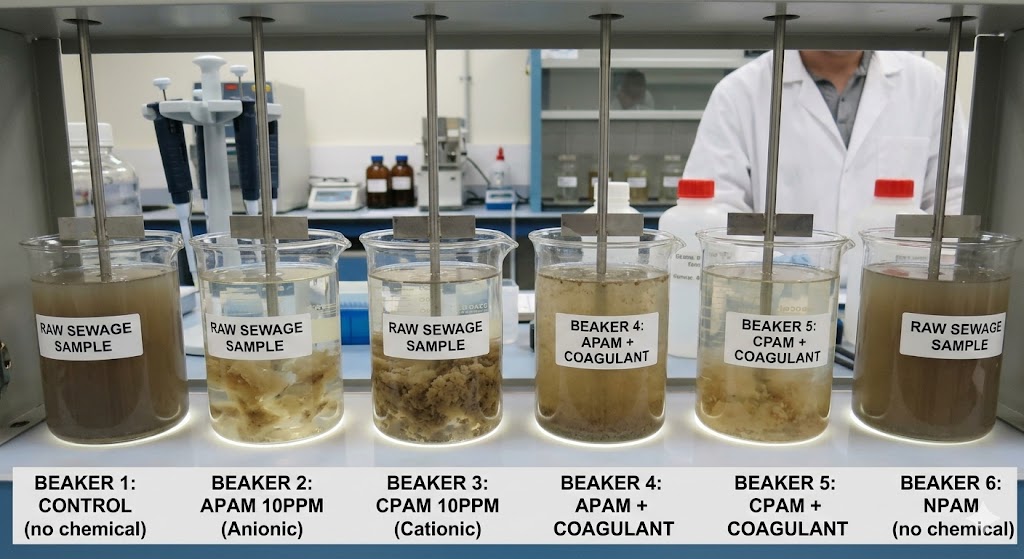
A jar test takes 30–45 minutes and can save thousands of dollars in wrong chemical purchases. Test at least 3 dosage levels (e.g., 1, 2, 4 mg/L) and observe:
● Floc formation speed
● Floc size and strength
● Settled sludge volume
● Treated water clarity
For detailed jar test procedures, see our guide: How to Perform a Water Treatment Jar Test.
Using cationic PAM in water with a coagulant already addedIf PAC or alum is already producing positively charged flocs, adding CPAM can cause charge reversal and break up flocs. Use anionic PAM as the flocculant in this case.
Selecting by price instead of charge matchAnionic PAM costs 30–50% less than cationic PAM per kilogram. But using the wrong type can double or triple the required dosage, eliminating any cost advantage.
Assuming one product works for all plant stagesMany facilities need different PAM types for different stages: APAM in the clarifier, CPAM in the sludge dewatering press. Using the same product throughout reduces efficiency.
| Decision Point | Anionic PAM | Cationic PAM |
|---|---|---|
| Particle type | Inorganic (mineral, silt) | Organic (biological, oil) |
| Treatment stage | Clarification, coagulant aid | Sludge dewatering, flotation |
| Water type | Raw water, mining effluent | Sewage, food/paper wastewater |
| Cost | Lower | Higher but more efficient per application |
When in doubt, run a jar test and compare both types side by side. The results are usually clear within 20 minutes.
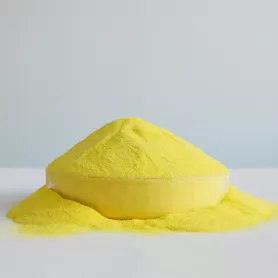
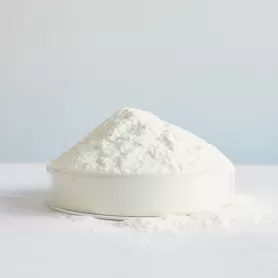
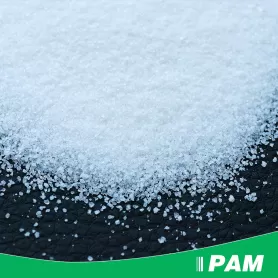
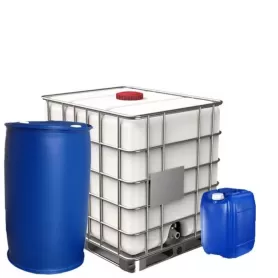
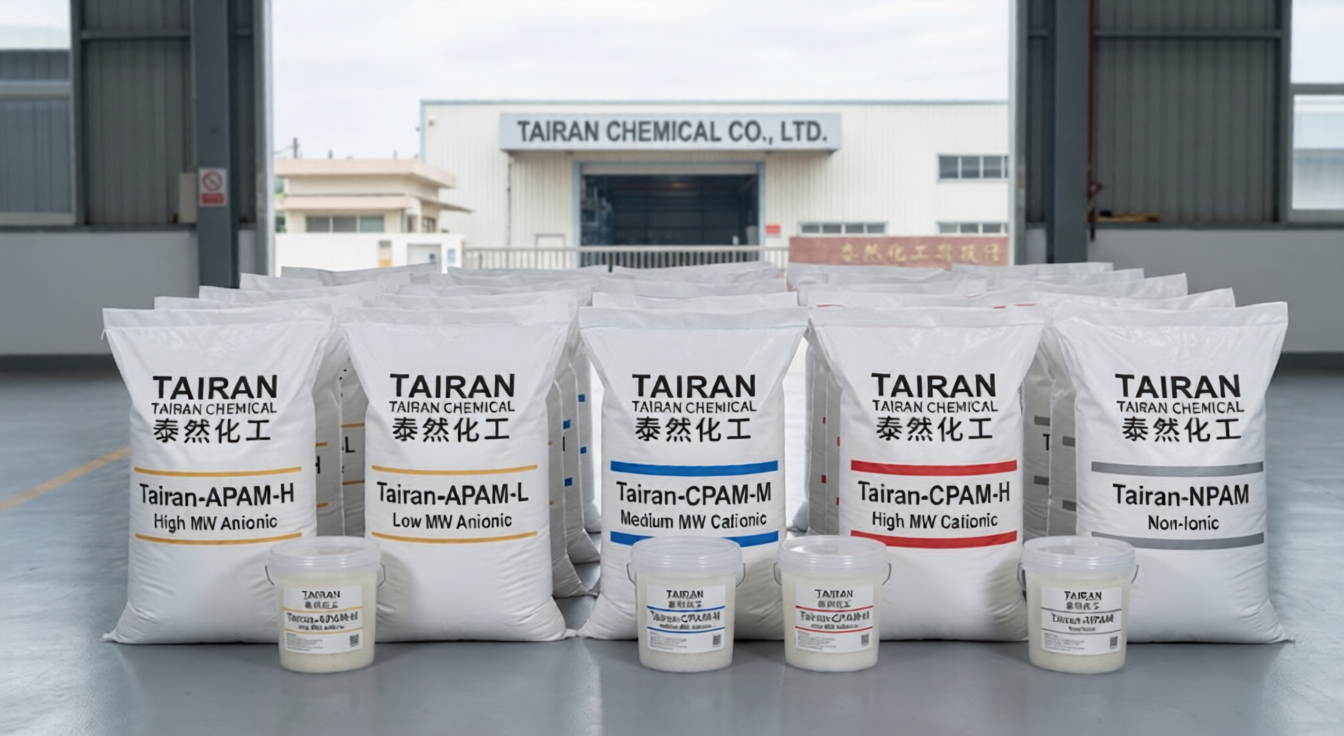
Tairan Chemical supplies both anionic and cationic polyacrylamide in powder and emulsion form, with charge densities ranging from 10% to 80% and molecular weights from 4 to 20 million Da.
Our technical team can recommend the right specification based on your water analysis data. Contact us or request a free sample to get started.
Related articles:
● How to Prepare PAC Solution: Complete Guide 2026
● PAM for Mining Wastewater Treatment
● PAM for Textile Wastewater Treatment
● PAC vs Alum: Which Coagulant is Right for You?
Q: Can I mix anionic and cationic PAM together?No. Mixing them directly causes immediate precipitation and loss of both products. They must be added at different stages of treatment.
Q: Does pH affect which type to use?Yes. Cationic PAM performs best at pH 6–8. At high pH (above 9), its charge density decreases. Anionic PAM is stable across a wider pH range (5–10).
Q: How do I know if my PAM is working correctly?Good indicators: flocs form within 30–60 seconds of dosing, floc size is 0.5–3mm, settled water turbidity drops below 10 NTU. Poor floc formation usually means wrong ionic type or insufficient dosage.
Q: What molecular weight should I choose?Higher molecular weight (15–20 million Da) creates larger, faster-settling flocs but requires careful mixing to avoid breaking. Lower molecular weight (4–8 million Da) is better for dewatering presses where shear forces are high.