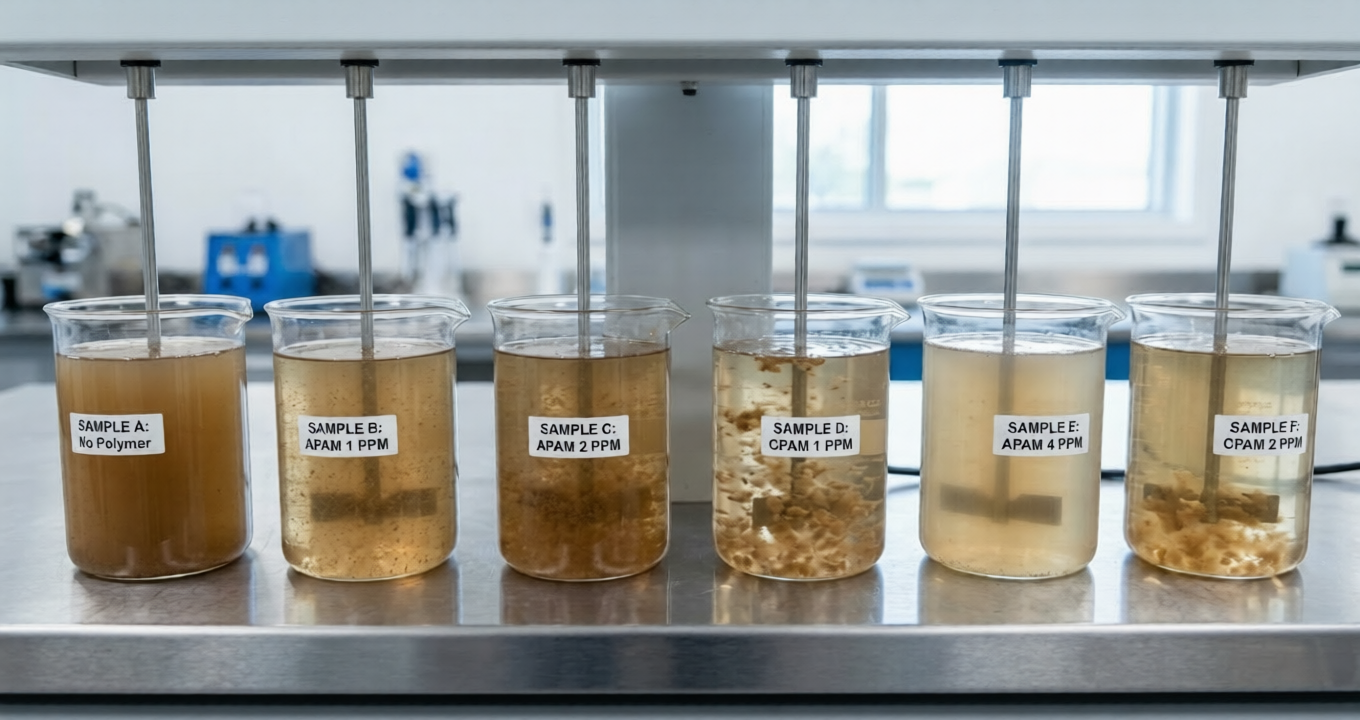
Running your water treatment plant without jar testing is like driving blindfolded. You might reach your destination, but you'll waste time, money, and potentially crash along the way.
A properly conducted jar test can reduce chemical costs by 20–40%, improve treated water quality, and prevent equipment fouling. Yet many operators skip it or perform it incorrectly, leading to overdosing, poor performance, and customer complaints.
This guide provides a complete jar test procedure for water treatment applications, including equipment setup, chemical testing protocols, and result interpretation.
A jar test is a laboratory simulation of your full-scale water treatment process. It allows you to test different chemical types and dosages side-by-side in small beakers before applying them to thousands of gallons in your plant.
Primary uses:
● Determining optimal coagulant dosage (PAC, alum, polyferric sulfate)
● Selecting the right flocculant type and dose (anionic vs cationic PAM)
● Optimizing pH adjustment requirements
● Comparing different chemical suppliers
● Troubleshooting treatment failures
Time investment: 45–60 minutes per testCost savings: $10,000–$50,000 annually (for a 1 MGD plant)
| Item | Specification | Cost Range | Alternative |
|---|---|---|---|
| Gang stirrer (6-paddle) | Variable speed 0-200 RPM | $800-$3,000 | Manual stirring (slower) |
| Glass beakers | 1,000 mL tall form, Ø 105mm | $50-$100/set | Plastic beakers (lower clarity) |
| Graduated cylinders | 1,000 mL, 100 mL, 10 mL | $60-$120 | Measuring cups (less accurate) |
| Turbidimeter | 0-1000 NTU range | $300-$2,000 | Visual clarity check |
| pH meter | ±0.1 pH accuracy | $100-$500 | pH paper (rough estimate) |
| Analytical balance | 0.01g precision | $200-$800 | Kitchen scale (lower precision) |
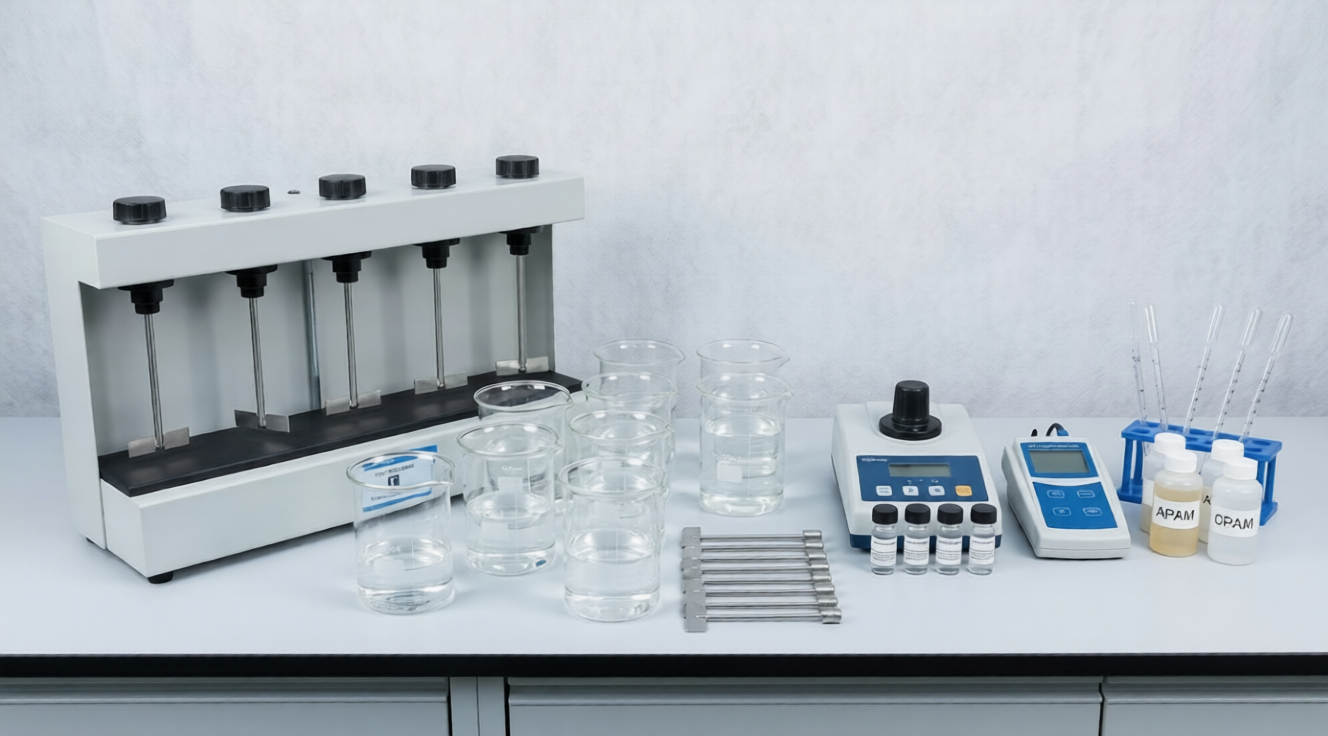
● Stock solutions of coagulants (PAC, alum, ferric)
● Stock solutions of flocculants (APAM, CPAM)
● pH adjustment chemicals (acid/base if needed)
● Distilled water for dilution
● Sample bottles
● Pipettes (1 mL, 5 mL, 10 mL)
Budget setup: $400-$600 (using alternatives)Professional setup: $2,000-$5,000
Critical: The sample must represent the water you're treating.
● Collect at least 8 liters (for 6 beakers + extra)
● Sample from the middle depth, not surface or bottom
● Mix well before transferring to beakers
● Test within 2 hours of collection
Record baseline parameters:
● Temperature (°C)
● pH
● Turbidity (NTU)
● Alkalinity (mg/L as CaCO₃)
● Color (if applicable)
Stock solutions allow precise dosing without handling tiny quantities of powder.
For coagulants (PAC, alum):
● Dissolve 10.0 g chemical in 1,000 mL distilled water
● Concentration: 10,000 mg/L
● Each 1 mL added to 1 L water = 10 mg/L dose
For flocculants (PAM):
● Dissolve 1.0 g powder in 1,000 mL distilled water
● Concentration: 1,000 mg/L
● Each 1 mL added to 1 L water = 1 mg/L dose
● Prepare fresh daily (PAM solutions degrade)
Mixing tip: Add powder to vortex of water slowly to prevent clumping.
● Measure exactly 1,000 mL into each beaker
● Use beakers of identical size and shape
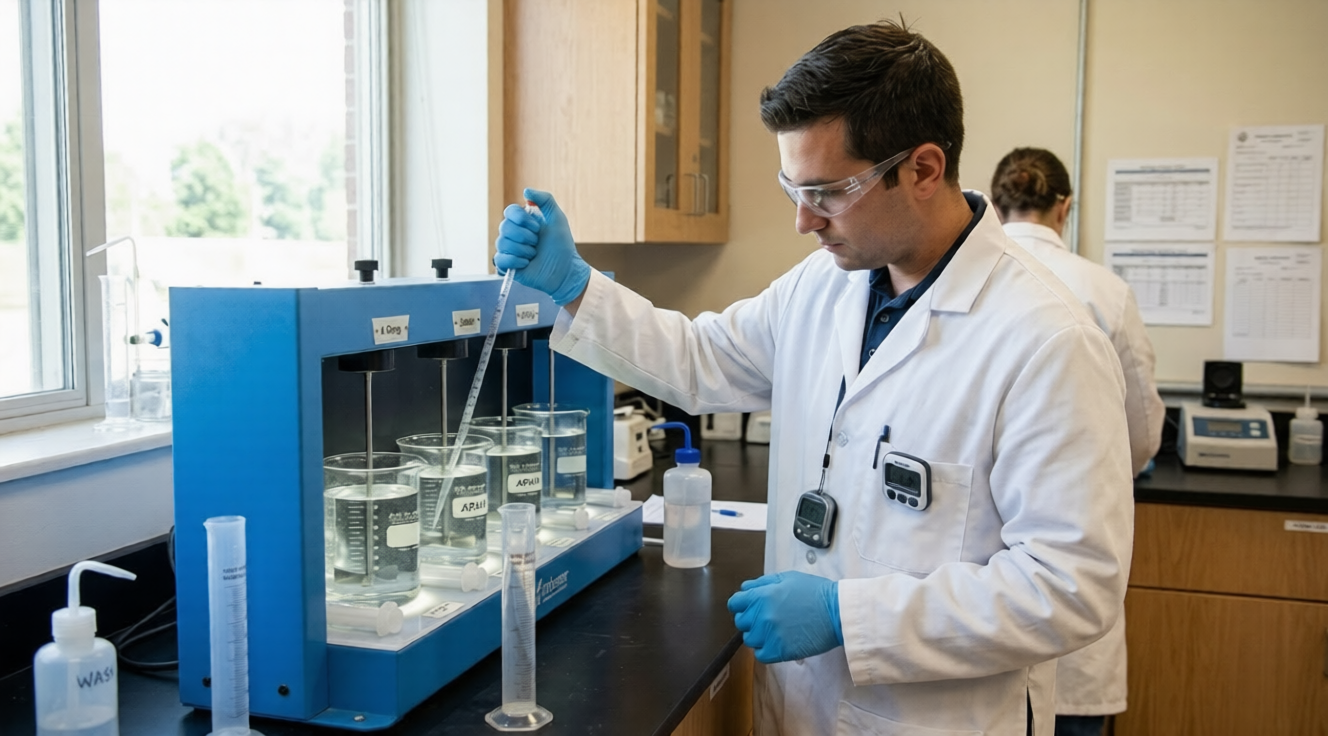
● Place beakers on gang stirrer
● Number beakers 1-6 for tracking
Test a range of doses around your expected optimal dose.
Example dosing plan for PAC:
| Beaker | Stock Solution Added | Final Dose |
|---|---|---|
| 1 | 2 mL | 20 mg/L |
| 2 | 3 mL | 30 mg/L |
| 3 | 4 mL | 40 mg/L |
| 4 | 5 mL | 50 mg/L |
| 5 | 6 mL | 60 mg/L |
| 6 | 8 mL | 80 mg/L |
Add coagulant rapidly to all beakers within 30 seconds.
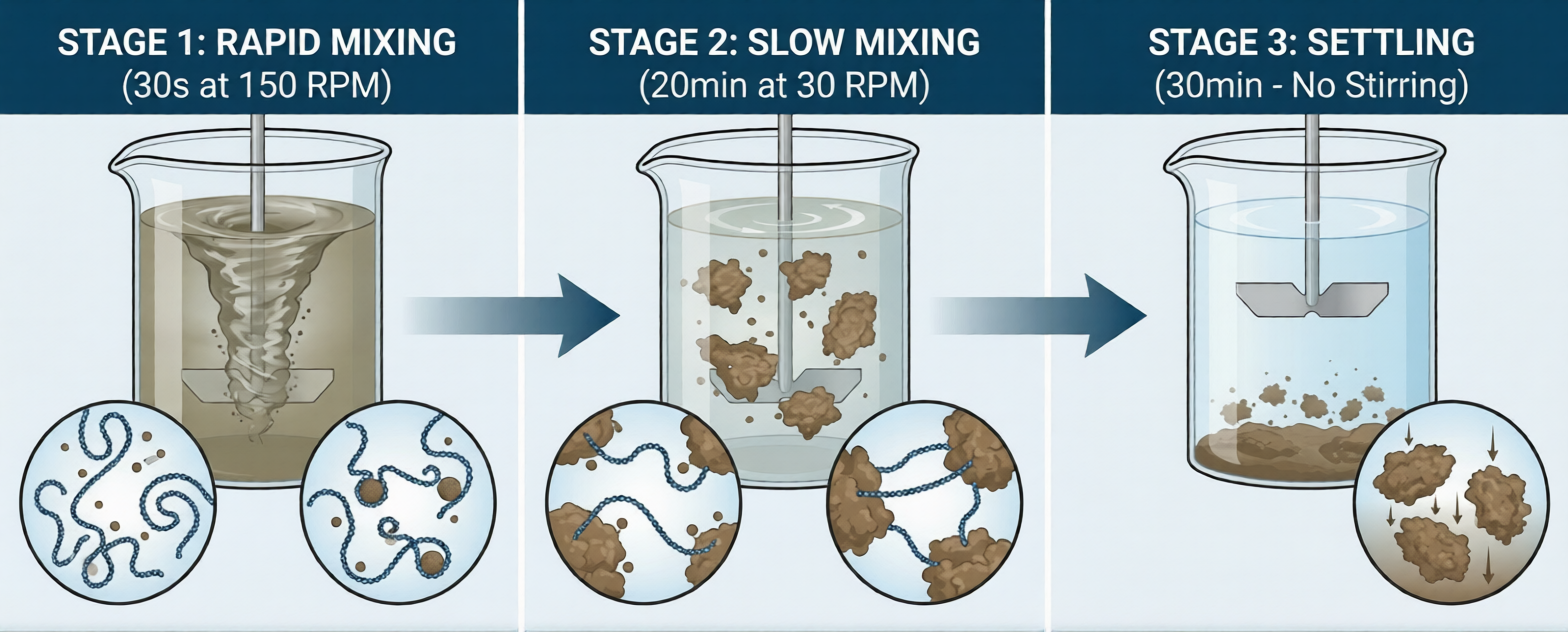
● Set stirrer speed: 100-150 RPM
● Duration: 1 minute
● Purpose: Distribute coagulant evenly throughout water
Watch for immediate turbidity reduction or color change.
● Reduce speed to: 30-40 RPM
● Duration: 15-20 minutes
● Purpose: Allow floc particles to grow and aggregate
Observe floc formation:
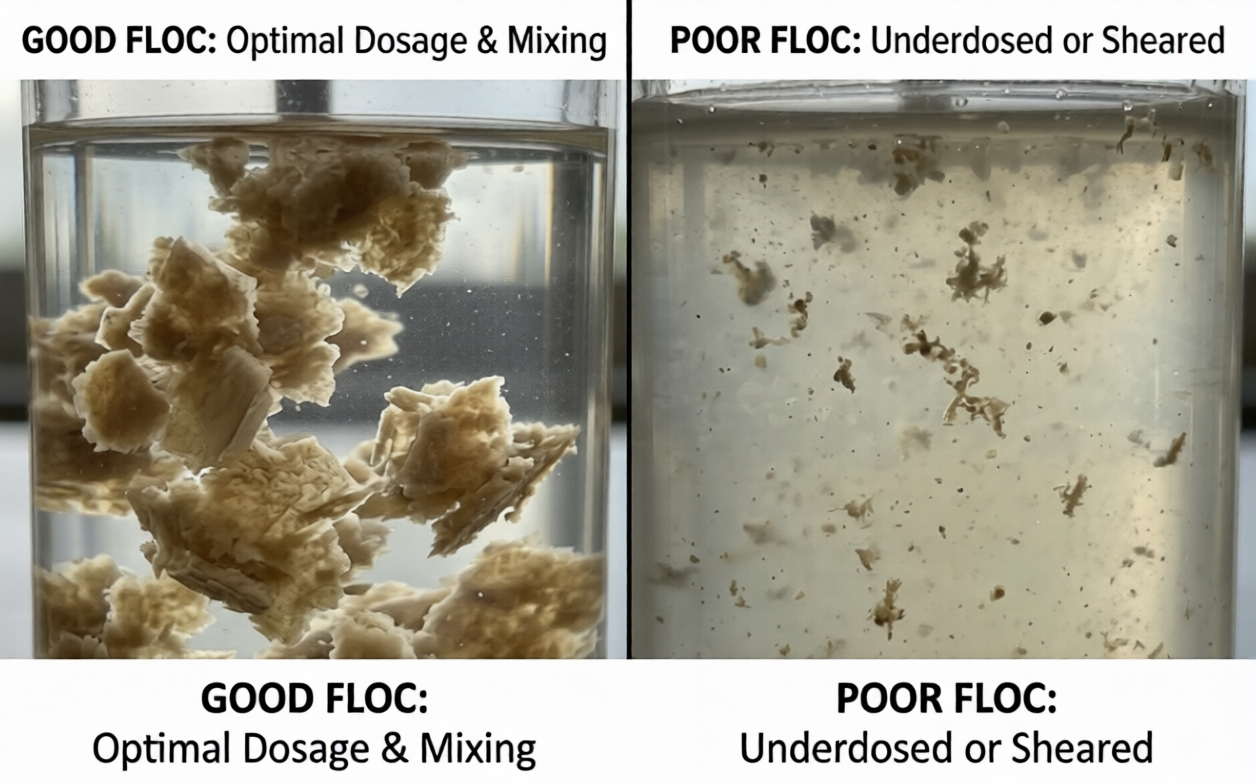
● Good floc: 2-5mm diameter, settling rapidly
● Poor floc: <1mm pinpoints, staying suspended
● Over-dosed: Broken, cloudy flocs
● Stop stirrer completely
● Allow settling: 20-30 minutes
● Do not disturb beakers
What to watch:
● Settling rate (faster = better)
● Floc compaction (tighter = better)
● Supernatant clarity (clearer = better)
Test supernatant from each beaker:
● Draw sample from 2cm below surface using pipette
● Measure turbidity (NTU)
● Check pH
● Visual clarity
Record sludge volume:
● Measure settled solids depth
● Less sludge = more efficient treatment
If using a two-chemical system (coagulant + flocculant):
After Step 6:
1. Select the best coagulant dose from initial test
2. Prepare new beakers with that dose
3. Add varying flocculant doses (0.5, 1, 2, 3, 4 mg/L)
4. Mix at 20-30 RPM for 3-5 minutes
5. Settle and compare
Critical: Test anionic vs cationic PAM separately — they cannot be mixed.
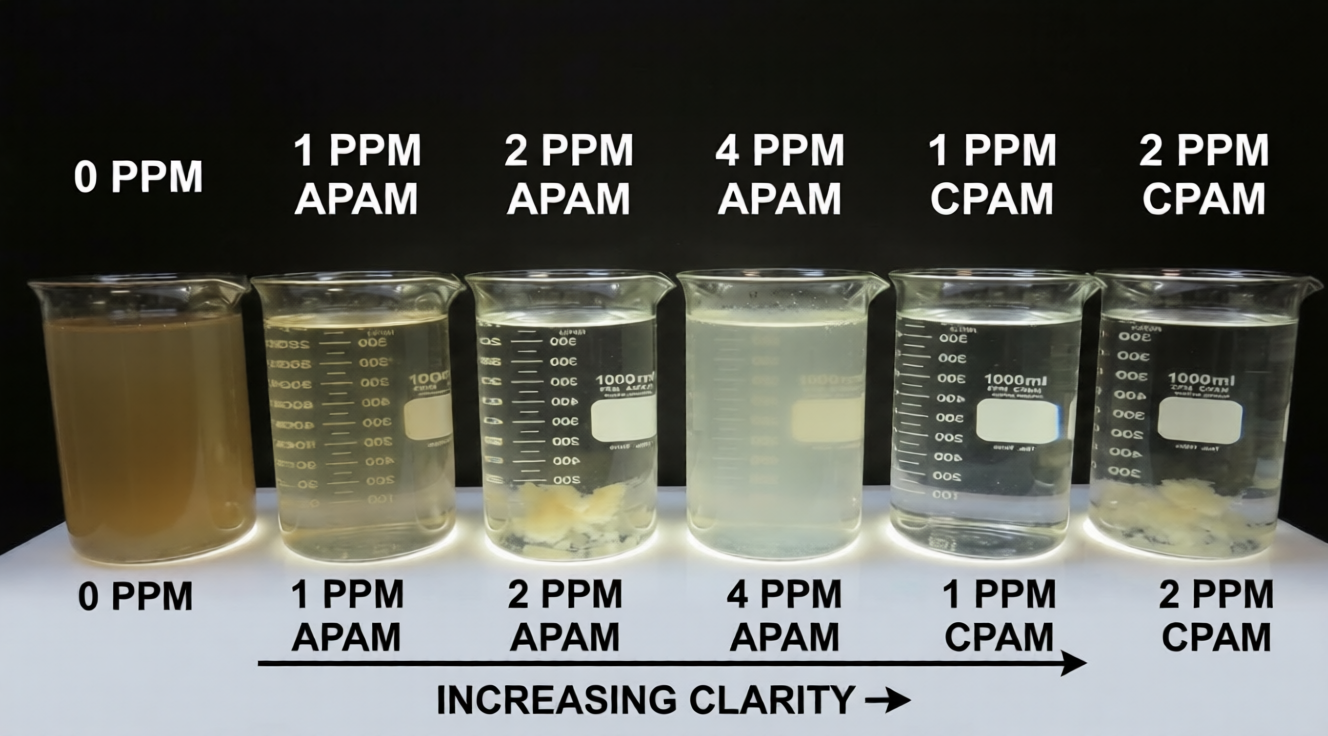
The "best" beaker is NOT always the clearest.
Consider all factors:
| Factor | What to Evaluate | Ideal Result |
|---|---|---|
| Turbidity | Lowest NTU | <5 NTU (drinking water) |
| <10 NTU (process water) | ||
| Floc quality | Size and settling | 2-5mm, settles in <10 min |
| Sludge volume | Settled solids depth | Minimized |
| pH stability | Final pH | Within target range |
| Cost | Chemical dose | Lowest effective dose |
Example decision:
● Beaker 3: 3 NTU, large flocs, high sludge volume
● Beaker 4: 4 NTU, medium flocs, low sludge volume
● Choose Beaker 4 (slight turbidity increase is acceptable for 30% less sludge)
Jar test results require adjustment for full-scale application.
Typical scaling factors:
● Conservative approach: Add 10-20% to jar test dose
● Aggressive approach: Use jar test dose directly, monitor closely
Why adjustment is needed:
● Mixing energy differs
● Retention time varies
● Temperature fluctuations
● Water quality variations
Best practice: Start at +15% jar test dose, then fine-tune based on plant performance.
Using old water samplesSamples degrade within hours. Turbidity can settle, pH can drift, organics can decompose. Test within 2 hours of collection.
Inconsistent mixing speedsIf paddles rotate at different speeds, results are invalid. Calibrate your gang stirrer regularly.
Testing only one chemical typeAlways test at least 3-4 dose levels. One data point is not a trend.
Ignoring floc characteristicsClear water with tiny, slow-settling flocs will clog filters. Prioritize floc size and settling rate.
Skipping pH measurementCoagulants consume alkalinity and change pH. If final pH is outside your target range, pre-adjust or switch chemicals.
| Situation | Frequency | Reason |
|---|---|---|
| Surface water treatment | Daily to weekly | Turbidity changes with weather |
| Groundwater treatment | Monthly | Stable quality, infrequent testing |
| After heavy rain | Immediately | Turbidity spikes require adjustment |
| New chemical supplier | Before switching | Verify performance equivalency |
| Customer complaints | Immediately | Diagnose treatment failure |
| Seasonal changes | Quarterly | Temperature affects chemistry |
Small municipal plant (1 MGD):
● Current PAC dose: 60 mg/L (no jar testing)
● Jar test optimal dose: 45 mg/L
● Savings: 25% chemical reduction
Annual savings calculation:
● Water treated: 1 MGD × 365 days = 365 million gallons
● Chemical saved: (60-45) × 365 × 3.785 = 20,739 kg
● Cost savings: 20,739 kg × $0.80/kg = $16,591/year
ROI: Jar test equipment ($2,000) pays for itself in 6 weeks.
Before starting:
● Collect fresh, representative sample
● Record baseline parameters (pH, turbidity, temp)
● Prepare stock solutions
● Calibrate equipment
During test:
● Use identical beakers and volumes
● Add chemicals quickly and consistently
● Follow exact timing (1 min rapid, 15-20 min slow)
● Observe floc formation carefully
After test:
● Measure turbidity and pH in all beakers
● Record sludge volumes
● Calculate cost per dose
● Scale dose to plant (+10-20%)
Tairan Chemical provides free jar testing support for customers evaluating PAC, anionic PAM, and cationic PAM products. Our technical team can:
● Recommend starting doses based on your water analysis
● Provide sample chemicals for jar testing
● Interpret results and suggest optimization
● Calculate chemical costs and ROI
Contact us or request samples to get started.
Related articles:
● How to Prepare PAC Solution: Complete Guide 2026
● Anionic vs Cationic PAM: Selection Guide
● PAC vs Alum: Which Coagulant is Right?
● PAM for Mining Wastewater Treatment
Q: Can I reuse water from jar tests?No. Once chemicals are added, the sample is contaminated and unsuitable for reuse or retesting.
Q: How accurate are jar test results?Jar tests predict full-scale dosing within ±15-25% when performed correctly. Always verify with plant trials.
Q: What if all six beakers look bad?Try a different chemical type (e.g., switch from alum to PAC), adjust pH before dosing, or increase dose range.
Q: Can I test multiple chemicals at once?No. Test coagulants first, then flocculants separately. Mixing chemical types in one test leads to confusing results.